This article is the second part of a three-part series on the political economy of the Black Nation, slavery, and feudalism in Northern Virginia.
Bloody Soil
Slavery was well practiced in Virginia, just like in all states south of the Mason-Dixon Line that divides Pennsylvania and Maryland. Some of the most notable events in the history of American slavery occurred in Virginia, including the first arrival of African slaves in the continental U.S. in 1619, Nat Turner’s slave rebellion in 1831, and John Brown’s rebellion in 1859*.
*John Brown’s rebellion occurred in territories that are now part of the state of West Virginia. At the time they occurred, they were located in Virginia.
Slavery and the implementation of slaves in the rearing of cash crops such as tobacco was central to Virginia’s economy up until the civil war. Many slave plantations existed right here in Northern Virginia, including famous ones such as Mount Vernon and Gunston Hall, as well as lesser known ones like Mount Air (the namesake of the neighborhood of Mount Air off of Telegraph Road in Newington)1 and Ravensworth, the namesake of Ravensworth Road in what is today Annandale.2
From the 17th century until the early 19th century, the slave economy in Virginia—including Northern Virginia—and Maryland, was primarily focused on the rearing of tobacco as a cash crop. The export of this commodity was at local market cities like Alexandria3, where they were then traded internationally. A number of economic factors led to the eventual decline of tobacco prices and the loss of profitability of tobacco as a cash crop. One factor was that tobacco was an intensive crop to harvest, and required extensive labor and land resources. Additionally, profit-focused land use practices led to the rapid exhaustion of arable land for tobacco. This was further compounded by the fact that white slaveowners and their descendants battled over increasingly subdivided tracts of inherited land. These factors meant that it was increasingly impossible to both grow tobacco and ensure subsistence for the slaves required to rear that tobacco, leading many planters to either move out west to more “virgin” lands, or to switch to somewhat less resource-intensive crops such as dairy, wheat, millet, and other grains. This legacy is still present in Northern Virginia in the number of roads named after mills: examples include Old Keene Mill Road, Old Mill Road, Grist Mill Road, Mill Road, etc.
In addition to the growth and sale of cash crops, Virginia was also heavily involved in breeding of slaves for sale and export. According to W. E. B. DuBois, between 50,000–80,000 slaves were exported from border states to the deep south. He cited an anonymous planter who said that he had calculated that “the moment a colored baby was born, it was worth to him $300,” which would be worth around $12,400 in 2024. He further cites English economist J. E. Cairnes who computed that between 1840 and 1850, Virginia exported “no less than 100,000 slaves, which at $500 per head would have yielded her $50 [million]”4, which would be worth around $2 billion in 2024. The breeding of slaves also incentivized slaveowners to rape their female slaves to produce as many offspring for sale as possible, as the legal status of the children of a slave was based on the status of the mother (i.e. if a male slave had a child with a white woman, the child would generally be free). This further underscores the sheer magnitude of just how much capital was accumulated from the rape, brutalization, exportation, and enslavement of Black people in Virginia alone. The centrality of this institution in accumulating capital in Virginia as well as in the Black Belt can not and should not be understated.
The relation of Black labor as slaves is markedly different to the relation of Black labor in the modern day as wage laborers. Namely, that the receipt of wages in return for the sale of labor-power was absent, and as highlighted in the prior passages from DuBois’ Black Reconstruction, they constitute owned property, similar to an oxen and cattle. Without their labor, the slave economic system could not survive. Slaves, like feudal serfs, do not have freedom of movement, do not receive wages, and are bound to their exploiters at the risk of bodily injury or death. The worker or wage-laborer has the “option” to choose which capitalist to whom they will sell their labor-power. The slave has no such choice, and the added value that they produce for their slavemasters is never seen by them from the day they are born until the day they are inevitably killed, one way or another, by their depressed conditions. The transition into wage-laborers would be initiated during Reconstruction era when the landowning planter class made an ultimately futile effort to resist the seizure of their slaves by the increasingly powerful capitalist class that won the civil war, and the conversion of those implements into wage laborers.
Slavery-based production held back the economic development of America as a whole. Consequently, it was destroyed by the more progressive budding capitalism of the north, facilitated by the Black slave revolts in the Black Belt. After this, the emerging Black Nation entered a transitory period during the Era of Reconstruction where much of the formerly enslaved Black people were transformed into sharecroppers (feudal peasants) and wage-laborers. However, even as observed by Lenin, much of the Black Nation remained in this semi-feudal state of existence well into the 20th century. In his 1915 publication New Data on the Laws Governing the Development of Capitalism in Agriculture:
“The United States of America, writes Mr. Himmer, is a ‘country which has never known feudalism and is free from its economic survivals’ (p. 41 of his article). This is the very opposite of the truth, for the economic survivals of slavery [i.e. sharecropping –Ed.] are not in any way distinguishable from those of feudalism, and in the former slave-owning South of the U.S.A. these survivals are still very powerful. It would not be worth while to dwell on Mr. Himmer’s mistake if it were merely one in a hastily written article.”
Sharecropping is an extreme form of tenant farming which differs from other forms of feudal tenant farming which existed in America at the time. Unlike non-sharecropping tenant farmers, who usually received between two-thirds and three-quarters of their harvest, sharecroppers only received half. It was from this half that rent, living expenses, as well as credit (with interest) was deducted from by the feudal landlords.10 As a result, sharecroppers received much less than half of their harvest, and their social conditions were marginally better than during the era of slavery. This feudal system lasted throughout the rest of the 19th century and into the early 20th century. At the time of Lenin’s publication of Laws of Development of Capitalism in Agriculture, the Black population constituted between 22.6–33.7% of the population of the deep south (higher than the national average at the time of 10.7%). Of the total number of farmers, 37% were tenants, 62.1% landowners, and 0.9% of farms were run by their managers. In the white population, 39.2% were tenant farmers, while among black population, 75.3% were tenant farmers. These conditions had disastrous effects for the social development of the Black Nation as well. For example, it was additionally observed by Lenin that the illiteracy rate for the white population over the age of 10 in 1900 was 6.2%, while among the Black population it reached nearly 45% – almost one in every two!5
It was these extremely depressed economic conditions under the feudal system of sharecropping that prompted the Black Nation to flee. It is well known that millions of Black people, in the first half of the 20th century, fled these horrid conditions to the north and west of the U.S. in what has been dubbed the Great Migration—they sought to escape the feudal system of exploitation and integrate into the industrial capitalist economy of the north as Black proletarians. This process led to the formation of many modern day Black communities outside of the Black Belt in many of America's largest metropolitan areas, such as Chicago, New York City, and Los Angeles. Lenin also drew a comparison between this and a process in Tsarist Russia that corresponds almost exactly with what was observed here in America: that of feudal serfs seeking to escape their oppression to regions and metropolitan areas with a higher level of capitalist development, to become wage-laborers rather than remain peasants.
“To show what the South is like, it is essential to add that its population is fleeing to other capitalist areas and to the towns, just as the peasantry in Russia is fleeing from the most backward central agricultural gubernias, where the survivals of serfdom have been most greatly preserved, in order to escape the rule of the notorious Markovs, to those areas of Russia which have a higher level of capitalist development, to the metropolitan cities, the industrial gubernias and the South.”5
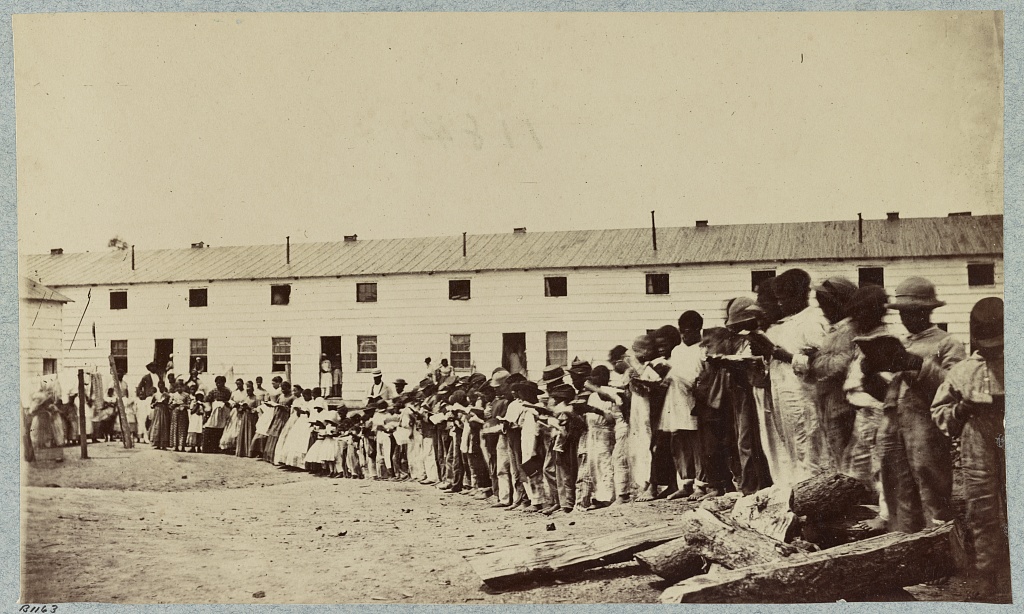
The Bureau of Refugees, Freedmen, and Abandoned Lands, known as the Freedmen’s Bureau, was created in March 1865 as a subdivision of the Department of War. The bureau was short-lived, but it played an important role as the interlocutor (on behalf of capitalism) between the former enslaved population and their former slave masters. As described by Fleischman et al., the planter class which mounted its final resistance against capitalism made use of the extensive use of the exception clause of the 13th Amendment which permitted slavery, to pass “vagrancy” laws. With such laws, freed people who did not carry proof of a labor contract signed by the Freedmen’s Bureau were labeled as “vagrants” and were under the threat of arrest. In addition, the institution of “Black Codes”, depressed wages, and the denial of rights for free Black laborers to fully participate in the economy, and enabled the arrest of “vagrants”, which enabled slavery to remain, in a much reduced capacity, with the ability for convict leasing to wealthy entrepreneurs. According to Fleischman et al., Mississippi was the first state in the south to institute Black Codes, doing so immediately after the end of the Civil War in 1865.6 They further describe the Black Codes as “unsubtle attempts to reinstitute policies that had been in place under the pre-war slave codes.” It was the context of these conditions that the Freedmen’s Bureau in Virginia found itself, and which Freedman’s Village, on what is today Arlington Cemetery and Ft. Myers, was brought up.